Screen Shot 2017-02-27 at 11.42.20 AM

You probably haven’t seen the old Fred Astaire movie Royal Wedding. Not everyone loves singing and dancing. I grew up watching Fred and Gene and Cyd and Ginger. God didn’t give me a dancer’s body, but He gave me the heart. Maybe you know what I mean. I draw dancers, dream of dancing, and can’t stop smiling when I get a chance to dance.

This post isn’t about dancing, so I’ll stop waxing on about it. It’s about singing. There is one line in Royal Wedding that often comes to mind when I’m feeling sad. Sarah Churchill’s character, Anne, tells Fred Astaire how she grew to be a professional dancer.

“I decided that if I dance when I’m happy, I would be happy when I danced.”

A few years ago I noticed a good indicator of how I was doing was how easily and often I caught myself singing or humming through the day. It revealed how joyful my heart was, how peacefully I was resting in God’s love.

Maybe I would go days or weeks singing less and less, and then singing in church would bring me to tears because I’d needed the action so badly. Only singing would release my heart to confront the weeds that had grown to disturb my rest in Him. Although it might be through tears, God restored the joy that grows from a steadfast hope in His goodness.

If I sang when I was happy, I would be happy when I sang. 

Yesterday was one of those days in church, when the spiritual discipline (a word that sounds too cardboard for the miraculous effect it has) of singing was the balm to my soul. How can I sing “Great is Thy Faithfulness” without having to honestly admit to God that the words are hard to confess? But confessing them in song was healing, like working out the scar tissue of an injury.

Today and in the coming days I’m choosing to listen to music with lyrics of trusting God, and I’m singing along at times, trusting God will use that act of faith to restore joy. I believe He will because being a good Father, loves it when we trust in Him.


{ 1 comment }

Jan
30
2017

The Box Keeper

IMG_0329

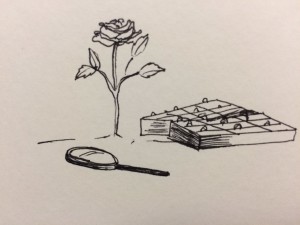
One morning the rose awoke to a pair of giant eyes studying her face, then the eyes backed away, and she saw that it was a man with very large eye glasses, and one of his eyes was magnified even more as he used a magnifying glass to look from the rose back to a box he held. She followed his eyes to the box he was looking at so closely. What was it? Then she looked around her, on the ground and all around the man were more boxes. Sitting on his knees near her, he had boxes all around him, and each box had smaller boxes inside. Each of the tiny boxes had labels.

Looking back at the man, the rose could see a very satisfied look on the man’s face. He seemed quite pleased with all of his boxes. She didn’t know why, but the boxes made the rose feel nervous. Despite her nerves, she bravely asked the man about the boxes.

“What are all of these?” she asked the man.

“Ah, these are roses.” Holding up one box so she could see, indeed, inside each tiny box in the large grid-like box was a limp, flat shape that looked like it had once been a flower, one under each label.”

“All roses? But they look different. There are no two the same,” said the rose.

“Exactly! I have one of each variety. Isn’t it marvelous? And it appears I already have one your species. See, right here,” and he pointed to one of the tiny boxes.

As he held it closer to her, she expected to see herself in the box, but what she saw was hardly a resemblance. A faded red, lifeless remnant of what she knew must have once been a beautiful rose rested captive in that tiny box. It was just a shadow of a rose.

“That’s you,” the man said proudly.

“I beg your pardon?” said the rose.

“Well, the same as you anyhow,” he said, jerking his chin proudly and looking away at all the other boxes still satisfied.

“How is that the same as me?” asked the rose, feeling quite offended.

“You have all the same characteristics and traits. I probably know more about you than you even know about yourself. I know how you’ll respond in all kinds of weather, and I know what your weaknesses are and how hearty you are. I know the best places for you to grow, and I can tell someone whether they should bother having you in their garden or not.”

The man acted like he knew what he was talking about, but the rose thought there must be more to it than that.

“That’s it?” asked the rose. “But look how different I am from the rose in the box. She didn’t live where I live. We have very different lives. We cannot be the same.”

“No, not exactly, but it must be the same circumstances that this rose would also survive in. I’m sure you would die if you had to face some of the things these other roses can handle. It’s silly for you to believe otherwise. Just accept it.”

“But surely you can see…”

“There’s no question about it,” interrupted the man. “That’s why labels are so convenient. We can study these things.”

The rose thought back over all the difficult days and nights since the prince had left. She felt sure the man would be surprised if he only knew how hearty she really was. As she watched him focus on neatly stacking all the boxes back together, she thought about asking him to consider how different she was from the rose he had said was the same as she. But the loud “clap clap” of his hands, shaking the dust off of them startled her, and she felt nervous again.

“I must be going. I have a few more roses I’m looking for. Too bad I already have your kind or I’d take you for my collection,” he said as he turned away.

You’ll never truly find them, she thought.

—————————-

This is a chapter in a book I work on from time to time, but this is the first I’ve shared.

{ 0 comments }

Jan
23
2017

hard words

How firm a foundation, ye saints of the Lord,
Is laid for your faith in His excellent Word!
What more can He say than to you He hath said,
You, who unto Jesus for refuge have fled?

Yesterday at church, we sang this old, familiar hymn. I’ve heard this song all my life, so how can the words take a deeper meaning each time I hear it over the years? Maybe it’s the way life is.

I think we sometimes believe life gets easier, or it should get easier as we get used to it, find our stride and make progress in self-perfection. But it doesn’t get “easier.” Those vain promises keep dangling beyond us, and each year we grow older, we face new trials, new lessons. I often think to myself that God cares more about my sanctification than I do. It’s true. He does.

When we sang this song, I’d just had a short conversation with an older woman at church. We’d just met in Sunday school, and in getting acquainted, she asked if I was single. “Yes,” I said, trying to decide whether I needed to brace for a staple platitude or prescription for the predicament.

Singleness wasn’t the half of it though. How could anyone guess the intense loneliness I’d felt since moving to Colorado? It was a different city, but the feeling was familiar. It had tried to bury me in Slovenia. It had tried to suffocate me in Oklahoma during a summer of working on support. Even it had a friend–depression. Together, they waged war on me. It wasn’t a fair match, and it was more than I could handle. Yeah, don’t let people tell you God won’t give you more than you can handle. He definitely will. But He had a good (loving, kind, faithful) reason–to nudge me in dependence on Him.

From a short testimony during class from this woman I mentioned, I knew she’d learned the same thing. I won’t mention what she shared, but it was something I hope to never have to face. Still, I cringed at the “it’s easy” tone that didn’t seem to relate to the current loneliness I’d been feeling. It’s easy to say “it’s going to be ok when you’re on the other side of a trial. And it’s tempting to offer a “get out of jail free” card to someone who’s in the midst of a trial. But our “if it’s uncomfortable, it must be bad” attitude towards trials is based on a lie that discomfort comes from the devil. I know this too shall pass, but what a waste it would be to hold my breath and wait for the waters to sink back down instead of seeking God in them.

As we sang this song, the line “When through the deep waters I call thee to go, The rivers of woe shall not thee overflow” was somehow comforting, acknowledging that God calls me into “deep waters” and “rivers of woe.” Though they might not overflow and be the end of me, they will rise.

We can’t compare griefs and weigh one life against another. Only God knows each of His children and what He is doing in and through each heart. But in that loneliness, that singleness before the Lord in which we each stand, we are given the choice whether to believe the truth in this old song, that He will not forsake us. To believe what God says about Himself requires faith every day, with each new trial. He grants us just enough somehow, even if it’s just enough for each day.

In every condition, in sickness, in health;
In poverty’s vale, or abounding in wealth;
At home and abroad, on the land, on the sea,
As thy days may demand, shall thy strength ever be.

Fear not, I am with thee, O be not dismayed,
For I am thy God and will still give thee aid;
I’ll strengthen and help thee, and cause thee to stand
Upheld by My righteous, omnipotent hand.

When through the deep waters I call thee to go,
The rivers of woe shall not thee overflow;
For I will be with thee, thy troubles to bless,
And sanctify to thee thy deepest distress.

When through fiery trials thy pathways shall lie,
My grace, all sufficient, shall be thy supply;
The flame shall not hurt thee; I only design
Thy dross to consume, and thy gold to refine.

Even down to old age all My people shall prove
My sovereign, eternal, unchangeable love;
And when hoary hairs shall their temples adorn,
Like lambs they shall still in My bosom be borne.

The soul that on Jesus has leaned for repose,
I will not, I will not desert to its foes;
That soul, though all hell should endeavor to shake,
I’ll never, no never, no never forsake.

{ 0 comments }

Dr. Lewis still scares me, but it’s a good thing. It’s hard to remember now all the classes I took with her, but as I learned to trust that she liked my writing and way of thinking, I wanted to take all I could.

I remember taking early American Lit. with her. We read about going into the wilderness and discovering that we can’t escape the fallenness in our own hearts, no matter how badly we want to escape the evils of the world.

Gladys Lewis was about my height, thin, wore large glasses that seemed almost too big for her face, but her gently out-swept silver hair allowed for the extra width at eye level. She had a wide-reaching smile that said so much more than happiness. It said “I, like your grandma, know everything you could be thinking right now, and I’m five steps ahead. So listen, and speak up when you learn something because I want to rejoice with you.” And she greeted us by calling us her “little cherubs.”

She seemed small compared to the giant anthologies she carried to each class. As she used both hands to pull open the Norton Anthology of 17th century British Lit, her big rings sparkled, and she grinned with delight at still getting to look into these ancient treasures.

One day in class, I was finally brave enough–almost brave enough to say something–and I guess I began to show that same smile or one like it. Dr. Lewis said, “Hayley? With your Mona Lisa smile?” looking directly at me. My heart pounded, and I knew she was waiting for me to say whatever likely not brilliant observation I’d made. I went ahead. And she said, “Mona Lisa speaks,” showing slight surprise with her eyebrows raised.

My face turned red. I couldn’t see it, but I could feel it.

I wasn’t the kind of teacher’s pet that constantly spoke up. I was the kind that only cared about the teachers I liked liking me. The ones I liked best knew I wanted to do well without having to speak up constantly.

In Victorian Lit, Dr. Lewis led us through four novels by Charles Dickens simultaneously. Yes, simultaneously. If you struggle keeping the characters straight in one, imagine the knots my mind was in. Sticky notes in each one, she would thumb through the pages and speak directly to “our good friend Charles.” She must have dreamt about the characters at night because it seemed like her relationships with them went beyond what was ever written on the page. Sometimes she took a grandmotherly tone talking to Pip.

When Dr. Lewis’ husband passed away, some other students and I went to the funeral.

Instead of teaching us in class, Gladys, wife of Wilbur, taught us from the warm oak pulpit of Presbyterian church. She taught us how to bravely and graciously speak the words that must have been so difficult because no one wants to voice affirmation that their beloved is gone. I sat amazed at her poise in such a difficult moment. I felt embarrassed that over the years, I was led to think we her students were her first love, when she had been simply giving out of an overflow–which is just how it should be.

I remember my last day of class before taking my comprehensive exams for my master’s degree. I knew it may have been my last class to ever take at university, and I knew it was my last class with Dr. Lewis. I cried off and on all through class. But I don’t think I cried as much that day as I did the day she returned to teaching after saying goodbye to her life-long love.

She thanked us for being there and for being patient with her over the past week. My eyes filled with tears as I looked down at my desk and wondered how she was able to carry on. Her posture was a little different, and she leaned a bit more on the desk. She was tired. Occasionally she took a folded kleenex from a pocket and dabbed her eyes, reaching under her large glasses, and gently put the tissue back.

When I think of people I’d like to be like some day, she’s always one of the first to come to mind. Whether I’m a professor of English or not, I want to learn her art of living by loving people around me, letting passion for the matter at hand catch me and others up in its spell, and remaining courageous no matter what sorrows God brings my way.

Dr. Lewis initially scared me because I was intimidated by her, but she still scares me in a way because as much as I want to be like her, I’m afraid of what it would take in my life to shape me in similar fashion.

{ 0 comments }


In the Bleak Midwinter

Text: Christina G. Rossetti, 1830-1894
Music: Gustav Holst, 1874-1934


In the bleak midwinter, frosty wind made moan,
earth stood hard as iron, water like a stone;
snow had fallen, snow on snow, snow on snow,
in the bleak midwinter, long ago.

Our God, heaven cannot hold him, nor earth sustain;
heaven and earth shall flee away when he comes to reign.
In the bleak midwinter a stable place sufficed
the Lord God Almighty, Jesus Christ.

Angels and archangels may have gathered there,
cherubim and seraphim thronged the air;
but his mother only, in her maiden bliss,
worshiped the beloved with a kiss.

What can I give him, poor as I am?
If I were a shepherd, I would bring a lamb;
if I were a Wise Man, I would do my part;
yet what I can I give him: give my heart.

It seems each year, a different Christmas carol haunts my mind, being the first one I naturally sing around the house or hum at the office. This year, that song is In the Bleak Midwinter. (Maybe part of its nudge to the forefront of my mind is owing to my reading Laura Ingalls Wilder’s The Long Winter.)

I was surprised last Sunday at church when our worship leader led us through this song, as it’s not one I hear much at church. Accompanied only by acoustic guitar, the congregation sang the melancholy tune, and tears streamed down my cheeks.

Again, I faced the simplicity of our dire need for a Savior and wonder at how God chose to meet that need. It was relief. It was the profound answer to not only the “desire of nations” but the need, the emptiness in every human heart. Not one person or thing had ever existed in our world that could meet that need until Jesus came.

As I said, I’ve been reading The Long Winter, and as I think about the bitter, harsh winters of unrelenting snowstorms my pioneer ancestors faced like Laura’s family did, it gives me a fresh picture of the unkind world Jesus willingly came into. At some points in the story, even Pa seems to lose hope that he and his precious family will survive the winter. They each lose their summertime cheeriness, and life becomes a monotonous cycle of survival. Binding hay to burn, grinding wheat to make into loaves, melting snow to drink, day after day until the hay and wheat nearly run out before the snow does.

The world Jesus came into was harsh. Enemies and the Enemy were after his life from the time he was born. Political unrest and religious hypocrisy and were as present then as they are now. He truly entered our world. “He was despised and rejected by men, a man of sorrows and acquainted with grief; and as one from whom men hide their faces he was despised, and we esteemed him not” (Isaiah 53:3).

When I hear the news of world events right now and think of the suffering people are enduring right now, I grieve the state of things. It is bleak. It is harsh. Yet this is exactly the place where the King of Kings chose to come and meet us. And as poor as I am to do anything to save myself, all He asks is that I trust in Him, my Hope, and give Him my heart.

In my family’s home hangs an old print of a collie calling out the rescue cry as it has found a lamb in the midst of a snowstorm. I have always loved this picture, and I think of it now as I think of friends and strangers–and myself–who are all in need of rescue. And the good news is, He has come.

collie

{ 2 comments }

Dec
01
2016

Missing a place

img_9119

I can still count the number of times I’ve walked the park near my new home on my fingers. It’s still new, but I’m keenly aware that it will be as well known to me as other paths have been in the past. And for that, I resent it a little.

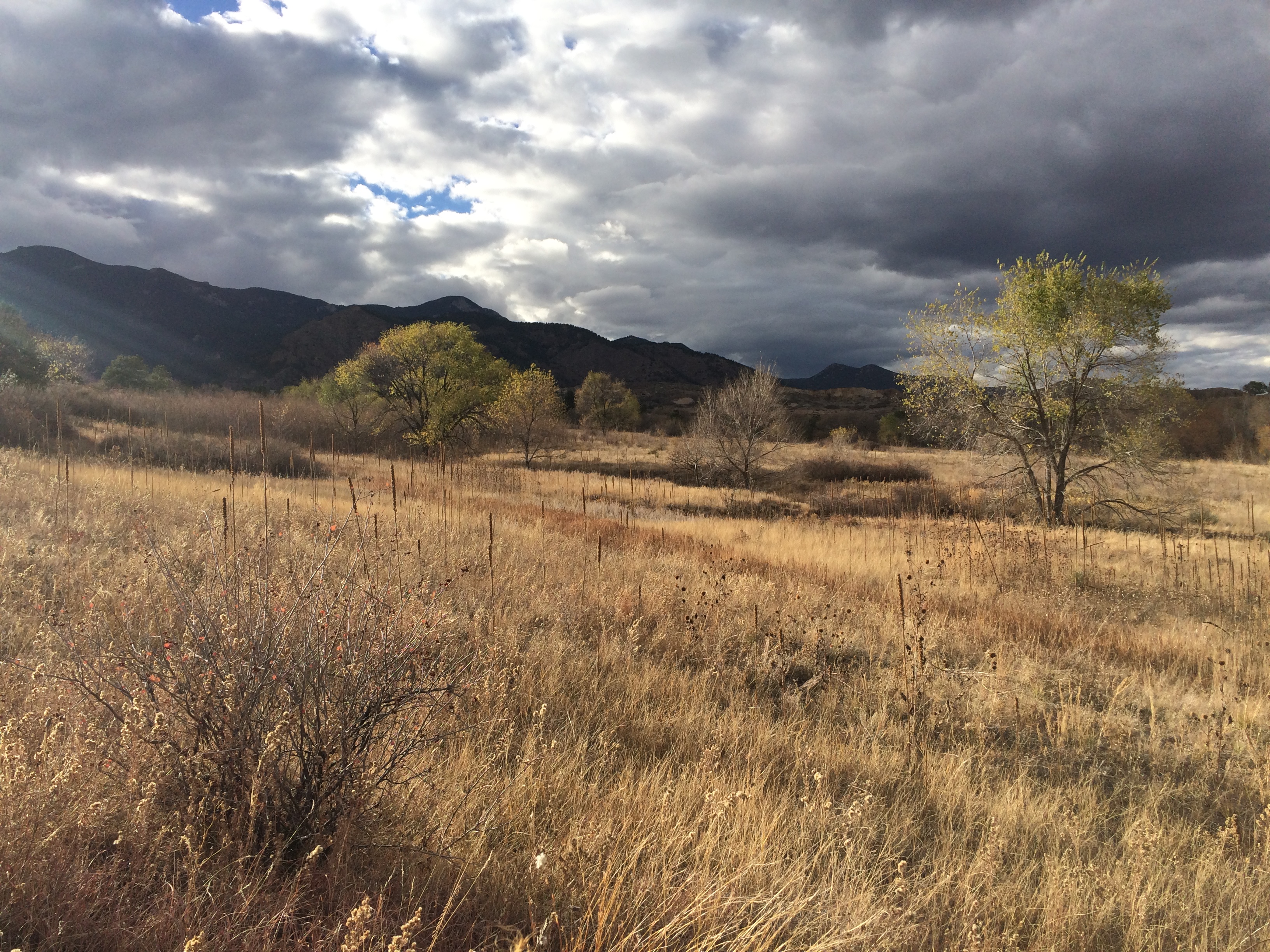
The other day as I walked the dirt paths through the yellow brush, I took time to be still on a bench at the top of a hill overlooking the park and facing the mountains. There was a name on the bench. An “in memory of” bench. I didn’t know who it was, what they looked like and why they would have that bench sitting in that spot in their memory.

And then a thousand (well, it felt like a thousand) thoughts and feelings brought tears to my eyes. If I had a bench somewhere in my memory, where would it be? And I missed Slovenia.

So far away were all my familiar spots on the trails near my house in Ljubljana. In these places I’d found comfort, quiet and the words I’d prayed to God, and sometimes I’d been reassured in the stillness that He didn’t need the words. I miss those places so much.

Places are important. I think that’s why God had people build memorials. They reminded the people of how God had spoken and worked in their lives. Whether it’s a spot on my trail in Slovenia, my Granny’s house in Duncan or the place I’d ride my bike as a kid, I treasure these places and grieve them somehow.

{ 0 comments }

Open like a lake

April 1, 2016

There’s a small lake on my running route this year. I love gazing at it as I pass, especially when it’s the foreground of a beautiful Florida sunset. It’s usually so still there’s a perfect reflection of the sky and trees on the smooth surface. So beautiful. It’s so peaceful. Almost every time I pass […]

Read the full post →

Jesus is Coming

December 22, 2015

As Christmas approaches this year, and I meditate on the coming of Jesus, I remember something a student said to me. Last year on campus in Slovenia, we changed up our little survey around Christmastime to be Christmas-themed. When I asked this student the reason for Jesus’ birth, she said it was to show us […]

Read the full post →

So much depends on a glass of milk

November 12, 2015

The Red Wheelbarrow by William Carlos Williams so much depends upon a red wheel barrow glazed with rain water beside the white chickens This is one of very few poems I remember studying in my junior year of high school. I loved it; others hated it. I often chose to love what others hated. I […]

Read the full post →

More than “fine”

October 1, 2015

People ask me all the time how the adjustment or re-entry is going. Usually I say fine. My friend, Katie, would never let me get away with that. She would say, “Don’t you know what that means? Freak-out, insecure, neurotic and emotional.” When it comes to having a so-so day or even a bad day, […]

Read the full post →